Forage (aka carrying capacity) feeds the deer; deer feed the wolves; wolves keep the deer herd in balance with the forage. It's a nice model, but things don't always work that smoothly. Two previous posts discuss a mathematical model written in Excel that interactively explores some of the possible outcomes given initial conditions of deer herd size, number of wolves, intrinsic growth rates of deer and wolves, and the carrying capacity and carrying capacity variance factor. This latter is a random card designed to incorporate the unpredictable effects of climatic variation, forage decline, or other things that can change the amount of forage but are not predictable from one year to the next.
Previous posts on this topic are at:
http://misterkenblog.blogspot.com/2012/01/predator-vs-prey-mathematical-model.html
http://misterkenblog.blogspot.com/2011/12/predator-vs-prey-will-wolves-dominate.html
Ready to try you hand at creating your own scenarios? A simplified interactive model programmed in an Excel spreadsheet is available for the curious in Google Docs at
https://docs.google.com/spreadsheet/ccc?key=0AixHzIqC4EIYdGJ6VFgyLUl3UERKUEF4RUw1Z0dVMkE
There are eight variables in the model you can work with shown in the diagram below.
The population size of the deer herd (here it is 5000), deer growth rate, carrying capacity for the deer herd, variance in carrying capacity (K), wolf population (here it is 10), wolf pack growth rate, predator efficiency, and number of deer required for wolf survival. You can change any and all of these starting numbers to see what happens. For example, to evaluate the effect of dramatic swings in climate try changing the variance in K (now at 2000) to a higher or lower number. A higher number would represent greater unpredictability and a lower number a more stable environment.
Have fun.
Showing posts with label deer and wolves. Show all posts
Friday, February 10, 2012
Tuesday, January 31, 2012
Predator vs Prey - A Mathematical Model - Part 2 of a 3 Part Series
In the first installment of my predator-prey model I presented graphs of population growth under three scenarios that included deer and forage but no predators. Scenario 1 was for a stable environment (i.e, constant carrying capacity): the deer herd rapidly grew from a starting population until it reached the carrying capacity then leveled out. Scenario 2 was a moderately variable environment and the deer initially grew but the population fluctuated above and below the carrying capacity. Scenario 3 was for a highly variable environment. In this last case, the deer herd grew, fluctuated in number, then crashed and died out. For a more complete review see http://misterkenblog.blogspot.com/2011/12/predator-vs-prey-will-wolves-dominate.html.
What happens when predators are introduced? Will the deer herd die out sooner or will it stabilize because wolves keep the deer herd in check with the environment? Can predictions even be made? Let's see.
Scenario 1: Start with a deer herd well below the carrying capacity, a small number of wolves, and a constant environment.
The starting conditions are an initial deer population (N) of 5000, a growth rate (R) of 0.5(50% increase in deer herd per generation), carrying capacity (K) of 20000, no variance in the carrying capacity (KV=0), 5 wolves, a reproductive capacity of 0.1 (10%), and a predator efficiency (E) of 0.53 (53% - VERY good hunters), and a requirement (S) of 24 deer/wolf/year to sustain wolf pack growth.
Both the deer herd and wolf pack show rapid initial growth, followed by oscillations of population size, and finally a steady state based on the carrying capacity for the deer herd. The final steady state is well above the starting conditions for both deer and wolves and the final state for the deer is about half of the carrying capacity.
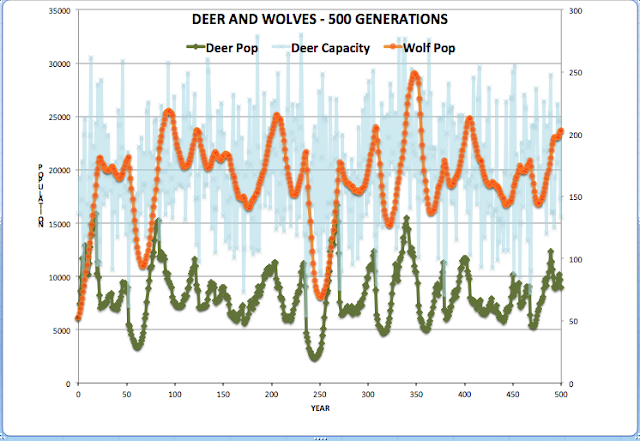
Scenario 2: Add global warming or some other factor to make the environment variable
The variance for the carrying capacity has been increased from 0 to 1000, or a variance factor of 20% (100x1000/5000).
The oscillations in both deer and wolves has increased and no steady state is achieved although after 500 generations it does not appear that neither deer nor wolves are in danger of extinction.
Scenario 3: Scenario 2 with more predation by increasing the wolf pack from an initial 5 to 50
Increasing the initial number of wolves from 5 to 50 does not change the overall dynamics. It would appear that starting with an initial wolf pack of fewer than what is sustainable has little long term effect. I leave it for the reader to try other starting wolf pack sizes once I have posted the interactive spreadsheet.
Increasing the variance in carrying capacity to 100% dramatically shifts the oscillations in both the deer herd size and wolf pack numbers. While neither population crashes, they come perilously close. I leave it to the reader to try more simulations to see if the wolves, or deer, or both go to extinction under these conditions.
Scenario 5: Same as scenario 4 with initial carrying capacity cut in half
In this last scenario, the deer herd crashes and the wolves, lacking a food supply, follow.
Whether the wolves control the deer population or the deer control the wolf population is still an open question, but clearly the environment controls both. When the deer herd exceeds the carrying capacity of the environment extremes from one year to the next will ultimately result in a population crash. In the absence of predation, by this model, the deer herd will subsist only if the environment is very stable. If the environment is not stable (the normal course of events) predation pressure can help stabilize the deer herd by reducing the herd size and the odds that the deer herd will not exceed the carrying capacity are improved. Of course if the deer herd crashes so will the predators unless they have a reserve food source. That in fact is the case, but then it becomes a matter of energetics and whether switching to an alternative food supply for the predator is analogous to a drop in carrying capacity for the prey.
Next month I will post a link to the statistical model so that the reader can try some scenarios and draw their own conclusions.
What happens when predators are introduced? Will the deer herd die out sooner or will it stabilize because wolves keep the deer herd in check with the environment? Can predictions even be made? Let's see.
Scenario 1: Start with a deer herd well below the carrying capacity, a small number of wolves, and a constant environment.
The starting conditions are an initial deer population (N) of 5000, a growth rate (R) of 0.5(50% increase in deer herd per generation), carrying capacity (K) of 20000, no variance in the carrying capacity (KV=0), 5 wolves, a reproductive capacity of 0.1 (10%), and a predator efficiency (E) of 0.53 (53% - VERY good hunters), and a requirement (S) of 24 deer/wolf/year to sustain wolf pack growth.
Both the deer herd and wolf pack show rapid initial growth, followed by oscillations of population size, and finally a steady state based on the carrying capacity for the deer herd. The final steady state is well above the starting conditions for both deer and wolves and the final state for the deer is about half of the carrying capacity.
![]() |
| Predation in Stable Environmet |
Scenario 2: Add global warming or some other factor to make the environment variable
The variance for the carrying capacity has been increased from 0 to 1000, or a variance factor of 20% (100x1000/5000).
The oscillations in both deer and wolves has increased and no steady state is achieved although after 500 generations it does not appear that neither deer nor wolves are in danger of extinction.
![]() |
| Add Moderate Amount of Environmental Variability |
Scenario 3: Scenario 2 with more predation by increasing the wolf pack from an initial 5 to 50
Increasing the initial number of wolves from 5 to 50 does not change the overall dynamics. It would appear that starting with an initial wolf pack of fewer than what is sustainable has little long term effect. I leave it for the reader to try other starting wolf pack sizes once I have posted the interactive spreadsheet.
![]() |
| Increase Predation Pressure |
Scenario 4: Keep the starting wolf population at 50 and increase the environmental variability
Increasing the variance in carrying capacity to 100% dramatically shifts the oscillations in both the deer herd size and wolf pack numbers. While neither population crashes, they come perilously close. I leave it to the reader to try more simulations to see if the wolves, or deer, or both go to extinction under these conditions.
![]() |
| Increase Environmental Variability |
Scenario 5: Same as scenario 4 with initial carrying capacity cut in half
In this last scenario, the deer herd crashes and the wolves, lacking a food supply, follow.
![]() |
| Reduce Carrying Capacity |
Whether the wolves control the deer population or the deer control the wolf population is still an open question, but clearly the environment controls both. When the deer herd exceeds the carrying capacity of the environment extremes from one year to the next will ultimately result in a population crash. In the absence of predation, by this model, the deer herd will subsist only if the environment is very stable. If the environment is not stable (the normal course of events) predation pressure can help stabilize the deer herd by reducing the herd size and the odds that the deer herd will not exceed the carrying capacity are improved. Of course if the deer herd crashes so will the predators unless they have a reserve food source. That in fact is the case, but then it becomes a matter of energetics and whether switching to an alternative food supply for the predator is analogous to a drop in carrying capacity for the prey.
Next month I will post a link to the statistical model so that the reader can try some scenarios and draw their own conclusions.
Labels:
deer and wolves,
ecology,
environment,
math model,
simulation,
statistical
Subscribe to:
Posts (Atom)


