Search This Blog by Google

Search This Blog

Welcome to Dijemeric Visualizations

Where photography and mathematics intersect with some photography, some math, some math of photography, and an occasional tutorial.

Total Pageviews

Showing posts with label time lapse. Show all posts

Saturday, November 26, 2011

Sock Physics - Experiments with Static Electricity

Zap!  Pull your clothes from the dryer and unless you've used one of those funny smelling anti-static papers you just might get a shock of electricity.   When the clothes tumble in the dryer and the water is removed, electrons are removed from their bonding atoms and static charges build on the clothing the same way walking across a rug on a dry day builds charge which is then released with a zap when you touch a conducting surface, like a door knob.  Zap!

When I tossed my clothes into a pile for sorting, I  watched as a loose strand from one sock reached upward as to defy gravity but stayed tethered to the sock.   Even knowing why this is so (or at least one explanation) it fascinates.  Over the next few minutes I held off sorting the clothes and took a few photographs.


Fig 1: Back lit sock with strand balanced against gravity by the repulsive force of static electricity

Even more amazing (to me), was the fine structure in the hair-like appendages that stood in repulsion to the main strand due to the repulsive forces of like charges.  When electrons are removed from neutrally charged atoms, a net positive charge remains.  The force between like charges is a repulsive one so the individual strands are forced apart.


Fig 2: fine structure detail from Fig 1 showing small fibers of the sock in mutual repulsion.

A few minutes later, the long strand was clearly losing the battle against gravity as the collected charges slowly dissipated as nitrogen and oxygen molecules took them away.   


Fig 3: Strand 5 minutes later

Eventually, the rebellious strand lost its charge and rejoined the sock.  


Fig 4:  Composite showing positions of strand over 5 minutes as it loses charge and settles under the force of gravity
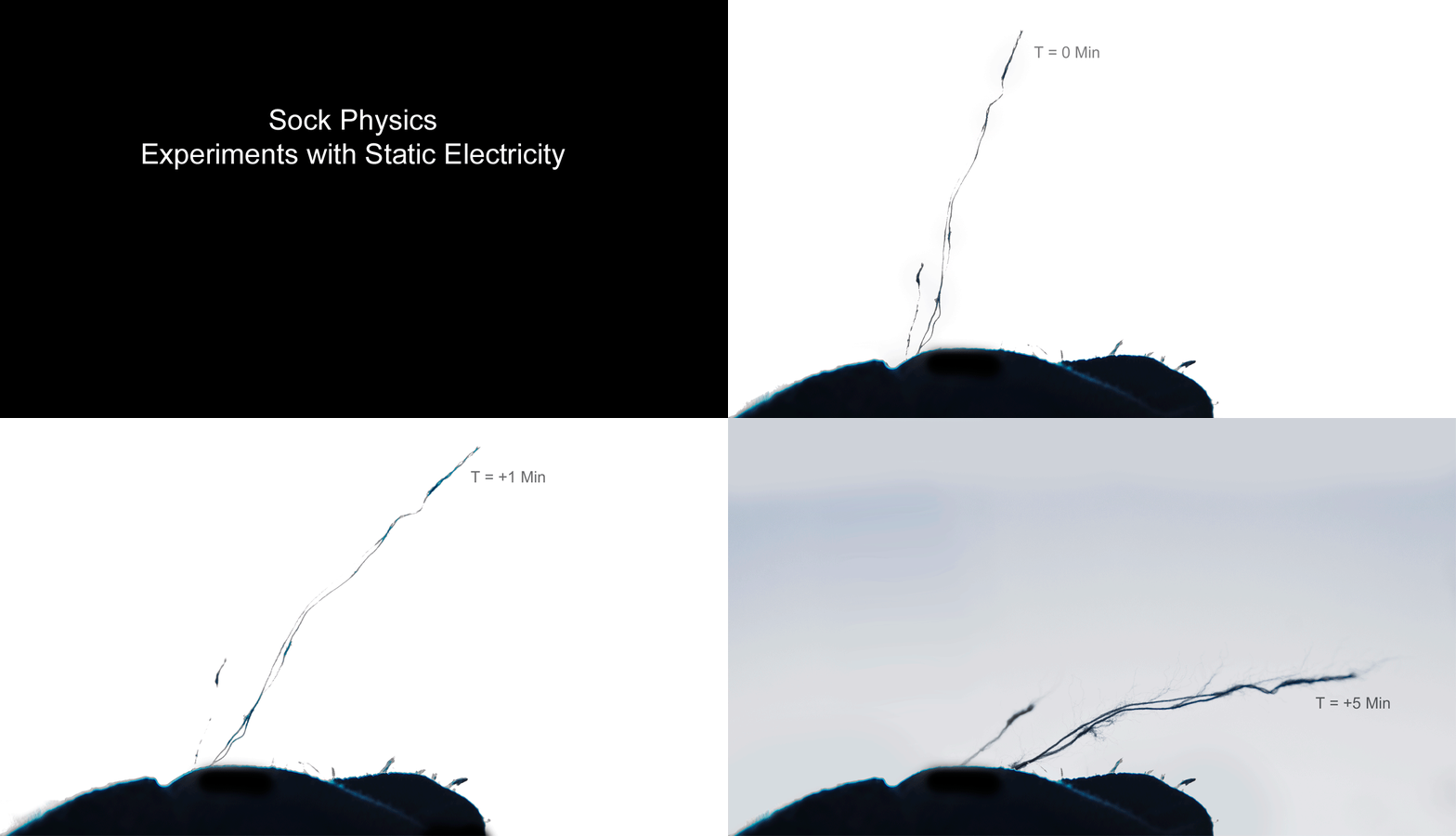

Fig 5: Mouse-click for animation 


Monday, October 31, 2011

Wildcat Creek in Time Lapse

Wildcat Creek did not run dry this year and still has a respectable flow. As I watched some leaves floating slowly by, I thought ahead when heavy rains will fill the creek above the rocks I was standing on. I also wondered how fast the leaves would be moving with the increased flow. One way to visualize this would be to take a time-lapse sequence!

Using the iPad I shot two sequences of 200 frames each. The first sequence was shot at 10 fps and the second at 1 fps. The two sequences were combined into a 40 second video using iMovie for the iPad and a soundtrack was added from a recording made a few years ago using a Sony MD Walkman. The first 20 seconds of the video shows the flow at normal speed and the second 20 seconds shows the flow at approximately 10 times normal speed. When the rains come, I can take a standard sequence and compare them. Perhaps not the most direct way to determine the comparative speed of flow in a creek, but it offers an alternative approach.

Wednesday, September 07, 2011

Sweet stuff - Time Lapse Photo-microscopy With an iPad 2

Sugar dissolves in water, right? Coffee drinkers know that and some who drink tea do too, but what happens if you put in more sugar than the water can hold? Place a few crystals of sugar on a microscope slide. Add a small drop of water and watch. If you are patient, you will see that at first the crystals dissolve rapidly, then the process slows and eventually seems to stop. As the water surrounding the sugar crystals hold more sugar molecules, the water becomes saturated. As molecules of sugar leave the surface of a crystal more molecules in the water return to the surface of the crystal. When the rates are equal, the water can hold no greater concentration and the crystals stop dissolving.

What if you put just one crystal into a drop of water? Or what if you added even more water to the saturated solution? To find out, watch the video.


http://youtu.be/bdEZ3W0croY